WWDC Isn't About Software Anymore
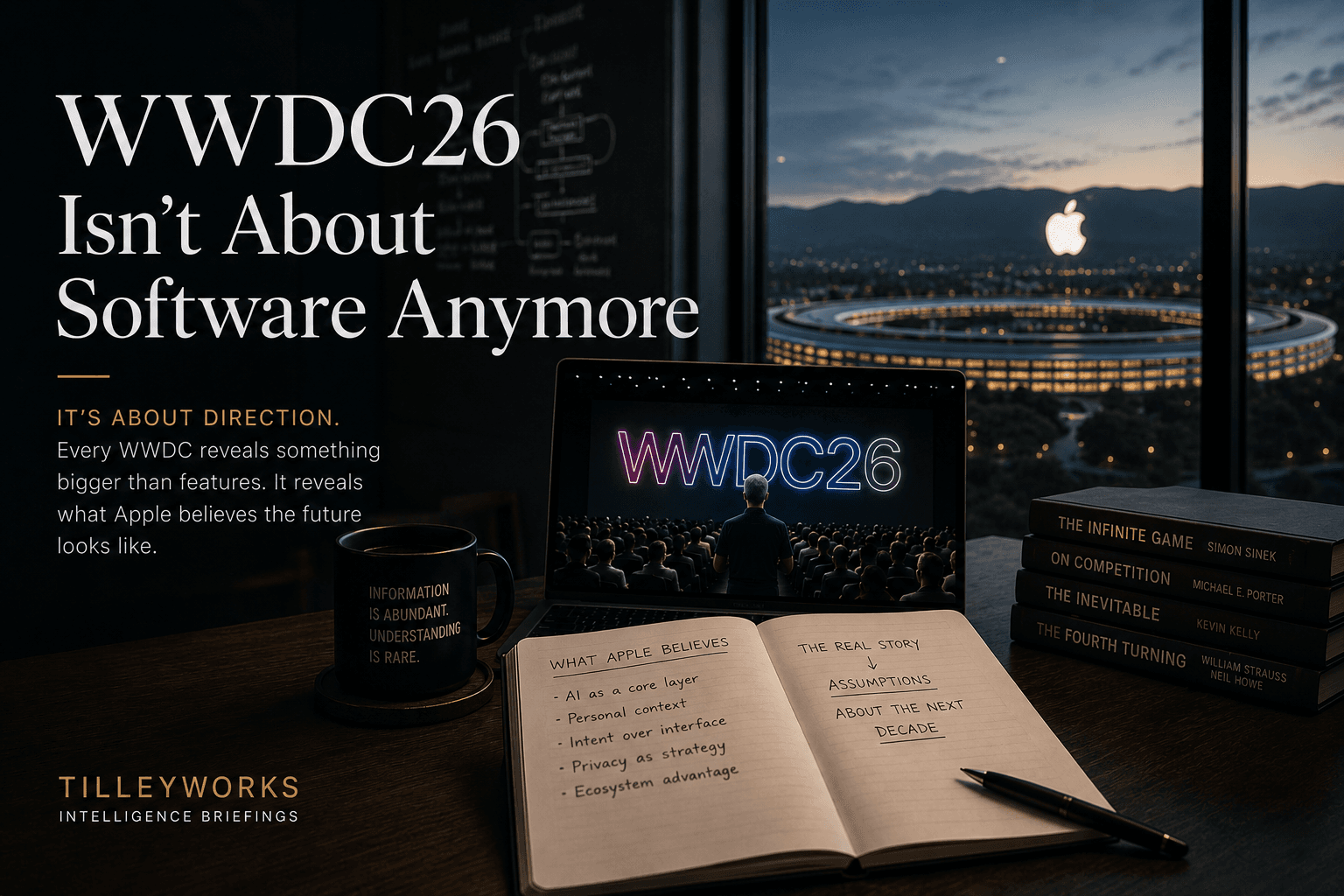
Every year, Apple hosts its Worldwide Developers Conference, better known as WWDC. For a few days, the technology world becomes consumed with operating systems, feature announcements, design changes, and whatever new capabilities are coming to the iPhone, iPad, Mac, and Apple Watch.
By the time the event concludes, countless articles will have been written explaining every detail. Technology websites will dissect every announcement. YouTube creators will produce hours of analysis. Social media feeds will fill with screenshots, opinions, and predictions about which features matter most.
There's nothing wrong with that. In many ways, that's exactly what these events are designed to generate.
But as I've watched WWDC over the years, I've become less interested in the features themselves and more interested in what those features reveal about the people building them.
The older I get, the more convinced I become that events are often less important than the assumptions behind them.
When Apple announces a new feature, they're not simply introducing software. They're revealing how they believe people will interact with technology in the future. Every decision, every design philosophy, and every major investment reflects a particular vision of where the world is heading. That's what I find interesting.
Most coverage of WWDC focuses on what Apple announced.
I find myself asking a different question.
What does Apple believe the next decade looks like?
One of the ideas I've explored here at TilleyWorks is the difference between information and understanding. Information tells us what happened. Understanding helps us determine why it matters.
WWDC is a perfect example.
It's easy to report that Apple introduced a new feature. It's much harder and far more interesting to consider what that feature says about the future of computing. Companies like Apple don't spend years developing products without a reason. Behind every announcement is a belief about consumer behavior, technology trends, and how people will use their devices five or ten years from now.
In many ways, WWDC serves as Apple's annual glimpse into the future. Not because Apple can predict what's coming, but because it reveals what the company is preparing for.
Whether those assumptions prove correct is another question entirely.
What stands out to me is how much the technology industry has shifted over the past several years. For decades, technology companies competed primarily on hardware specifications. Faster processors, larger screens, better cameras, and more storage defined much of the conversation.
Today, the competition feels fundamentally different.
Artificial intelligence, automation, personal assistants, and software ecosystems are all pursuing a similar objective: helping people manage complexity. We live in a world where information is abundant, but attention is increasingly scarce. The challenge isn't finding information anymore. The challenge is making sense of it.
That's why so much of modern technology seems focused on reducing friction. The companies shaping the future are not simply building tools. They're building systems designed to help people navigate an increasingly complicated world.
Apple's approach may differ from Microsoft's. Microsoft's may differ from OpenAI's. But beneath the surface, they're all attempting to solve a similar problem.
How do you help humans manage more information without becoming overwhelmed by it?
What's interesting is that this trend extends far beyond technology.
I see it in business. I see it in media. I see it in markets.
The organizations that create the most value are often the ones that simplify complexity for others. The dealership that makes buying easier. The software company that makes complicated tasks feel intuitive. The publication that helps readers understand a difficult topic without oversimplifying it.
The principle remains the same.
As complexity increases, clarity becomes more valuable.
That may be one of the defining characteristics of the next decade. We aren't running out of information. If anything, we're drowning in it. What becomes scarce is perspective. Context. Understanding.
Those are the resources people increasingly need.
That's why I believe events like WWDC matter.
Not because every feature announced will change the world. Most won't. Many will be forgotten within a year. Some will never gain traction at all.
What matters is the direction.
Every major technology company is making decisions based on how they believe people will live, work, communicate, and interact with information in the future. Watching those decisions unfold provides insight into much larger trends than any individual software update ever could.
Perhaps that's the difference between following technology news and studying technology systems.
One focuses on the announcement.
The other focuses on the assumptions behind it.
For me, that's where the real story begins.
——
About the Author
Scott Tilley is the founder of TilleyWorks, an independent operational media company exploring media, markets, technology, and systems. Through Intelligence Briefings and Media Broadcasts, he shares observations, analysis, and perspectives designed to help readers better understand a rapidly changing world.