Media vs. Operational Media
One of the questions I get asked most often is simple:
"What exactly is operational media?"
It's a fair question.
The truth is, I didn't set out to build an operational media company. In fact, when I first started creating content, I wasn't thinking about media at all. I was streaming, building communities, talking with people, and sharing whatever happened to be on my mind that day.
Over time, however, I noticed something that I couldn't stop thinking about.
The more information available to us, the harder it seemed for people to understand what was actually happening.
At first glance, that doesn't make much sense. We have access to more news, more data, more opinions, and more content than any generation in history. Information is everywhere. It's in our pockets, on our desks, and constantly competing for our attention. Yet despite all of that access, many people feel overwhelmed, confused, or unsure of what to believe.
I think part of the reason is that information and understanding are not the same thing.
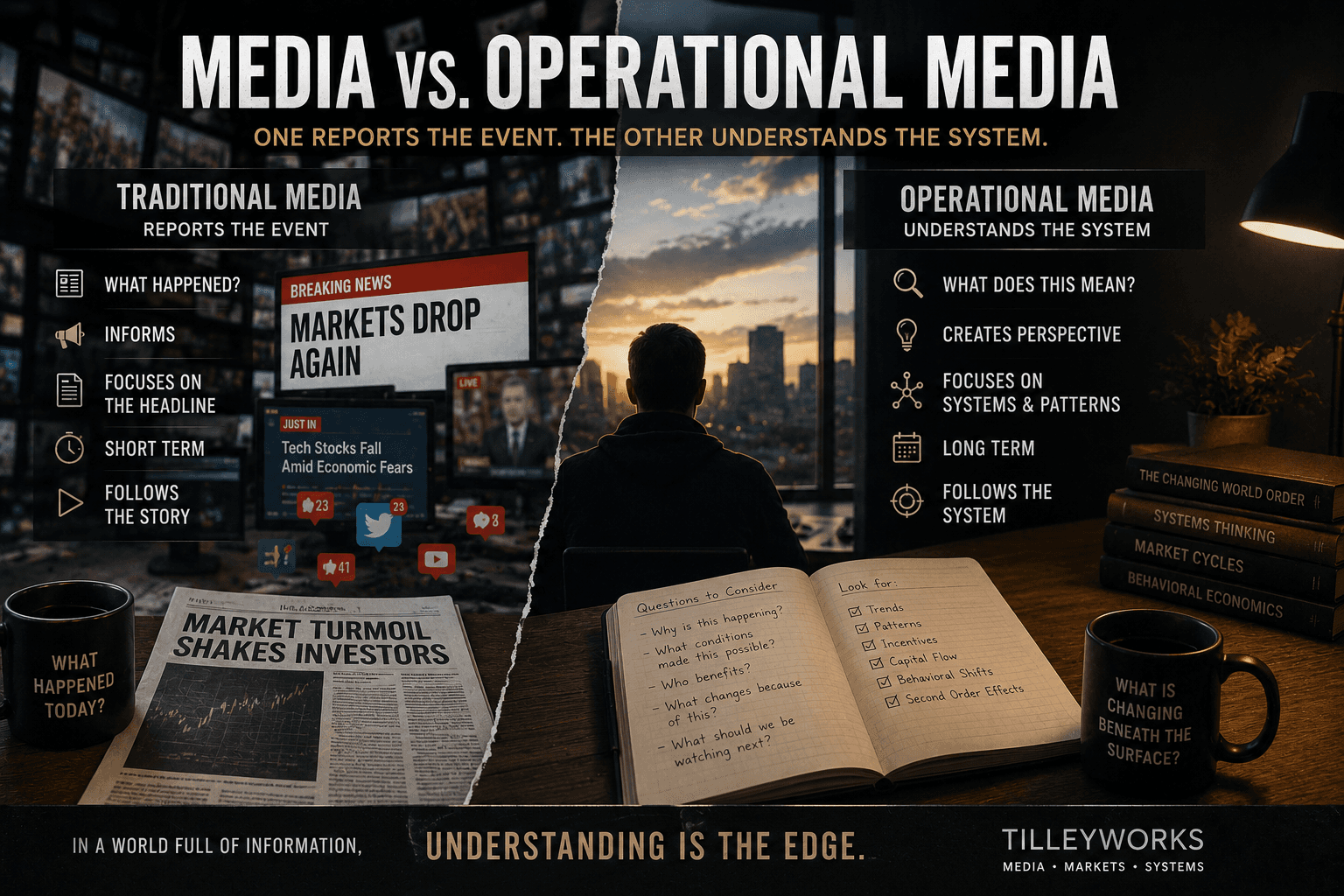
Most media is designed to tell us what happened. Operational media is concerned with understanding what it means.
Traditional media serves an important purpose. It reports events, informs the public, and helps people stay aware of what's happening in the world. There's tremendous value in that. We need people gathering facts, reporting developments, and documenting events as they unfold.
But the story often ends there.
A headline tells you what happened. An article provides details. The audience consumes the information and moves on to the next story. The cycle repeats itself over and over again.
Operational media begins where that cycle ends. Instead of focusing exclusively on the event, it becomes interested in the forces that produced the event in the first place. It asks different questions. Why is this happening? What changed? What trends are emerging? What does this tell us about the larger system?
The goal isn't to chase headlines.
The goal is to understand context.
I see this in business every day.
Imagine a dealership suddenly experiences a decline in sales. The event is easy to identify. Sales are down.
But the event itself isn't particularly useful unless you understand what's causing it.
Is consumer confidence weakening? Have financing conditions changed? Did inventory become constrained? Has customer behavior shifted?
An operator doesn't stop at the outcome.
An operator investigates the system producing the outcome.
The same principle applies to markets, technology, logistics, media, and even human behavior. Most people are watching events. A smaller group is studying systems.
Neither approach is inherently right or wrong. Both have value.
You need to know what happened before you can understand why it happened.
The challenge is that modern life bombards us with events while leaving very little room for reflection. We are surrounded by information but often starved for context.
That's the gap I want TilleyWorks to fill.
Not by pretending to have special knowledge.
Not by claiming certainty.
And certainly not by telling people what to think.
My goal is much simpler. I want to pay attention. I want to ask questions. I want to identify patterns, trends, and observations that might help people better understand the world around them.
Sometimes that means discussing markets. Sometimes it's technology. Sometimes it's media. Sometimes it's something as simple as a conversation, a book, or an observation that most people would overlook.
The common thread isn't the topic.
The common thread is curiosity.
If traditional media focuses on what happened, operational media focuses on understanding the environment that made it happen.
That's the difference.
Not a new industry.
Not a secret methodology.
Just a different way of looking at the world.
And in a world overflowing with information, I believe understanding may be one of the most valuable resources we have left.
-
Scott Tilley is the founder of TilleyWorks, an independent operational media company exploring media, markets, technology, and systems. Through Intelligence Briefings and Media Broadcasts, he shares observations, analysis, and perspectives designed to help readers better understand a rapidly changing world.