The Rise of Operational Intelligence
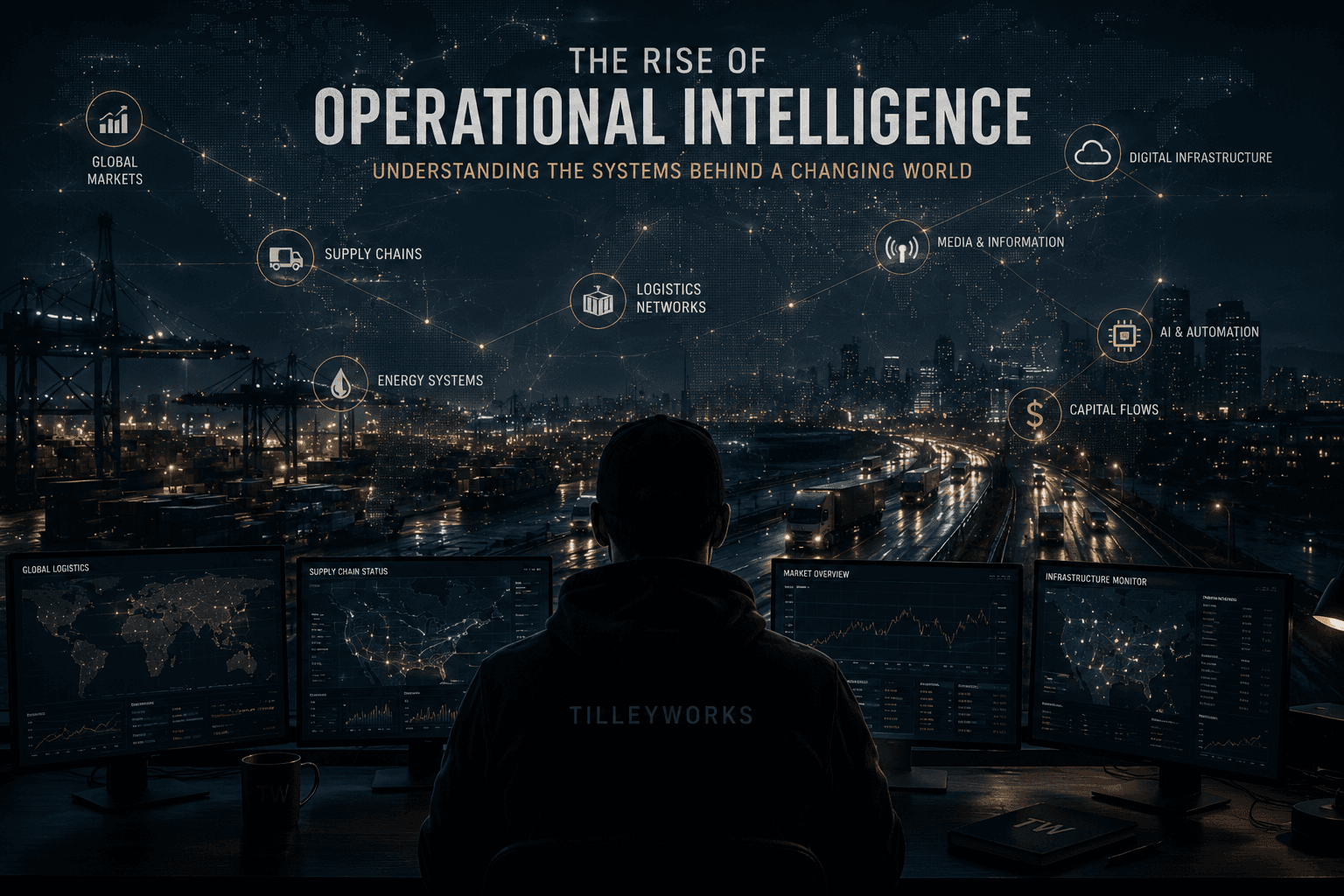
Most people can feel that something is changing.
The world feels faster than it used to.
More connected.
More unstable.
More difficult to fully understand.
Prices move suddenly.
Industries change overnight.
Artificial intelligence appears everywhere all at once.
Media feels increasingly chaotic.
Nobody seems to fully trust institutions anymore.
And every system somehow feels connected to every other system.
Because they are.
A problem at a shipping port affects store shelves hundreds of miles away. Fuel prices impact freight costs. Freight costs affect prices everywhere else. Markets react to inflation. Governments react to markets. Media reacts to all of it in real time.
Most people only see the final result:
higher prices,
slower deliveries,
market volatility,
political arguments,
or another breaking headline.
But underneath all of it are systems constantly interacting with one another behind the scenes.
That’s the part most people never really see.
And honestly, that’s part of what led to the creation of TilleyWorks Intelligence.
Over time, I started realizing that almost everything I was interested in somehow connected together:
markets,
logistics,
technology,
media,
operations,
infrastructure,
AI,
streaming,
business systems,
even simulation games built around transportation and operations.
At first those interests seemed unrelated.
But the deeper I looked, the more obvious the connections became.
A trucking route is connected to fuel.
Fuel is connected to energy markets.
Energy markets affect inflation.
Inflation affects interest rates.
Interest rates affect businesses, hiring, and investment.
Technology changes how those systems operate.
Media changes how people react to them.
Everything is connected.
The modern world increasingly runs on infrastructure most people never think about until something breaks:
shipping networks,
server infrastructure,
supply chains,
distribution systems,
payment systems,
data centers,
energy grids,
automation systems,
digital platforms.
Most of the time these systems remain invisible.
Until suddenly they aren’t.
That’s why operational thinking matters more now than it used to.
Not because anyone can predict the future perfectly.
Nobody can.
But because understanding how systems connect gives people a clearer picture of what’s actually happening beneath the surface.
Modern media often focuses on reactions instead of structure.
Constant updates.
Constant outrage.
Constant noise.
Operational intelligence is really just the opposite of that.
It’s stepping back long enough to ask:
What’s actually driving this?
What systems are involved?
What changed underneath the surface before everyone noticed the effects?
Sometimes the signals are small at first:
a delay in freight,
an increase in datacenter construction,
changes in manufacturing,
energy constraints,
automation replacing workflows,
or shifts in where capital is moving.
On their own, those things may not seem important.
But together, they often point toward much larger changes already happening.
That’s the part of the modern world I’ve become increasingly interested in exploring.
Not from the perspective of a giant institution or polished corporate media company, but from someone actively watching these systems evolve in real time while operating inside many of them every day.
That’s what TilleyWorks Intelligence is really about.
Observing systems.
Following signals.
Connecting dots.
Understanding infrastructure.
Watching how technology, logistics, media, AI, and markets increasingly shape one another.
Because the future probably won’t belong to the people consuming the most information.
It may belong to the people who understand how the systems behind that information actually work.